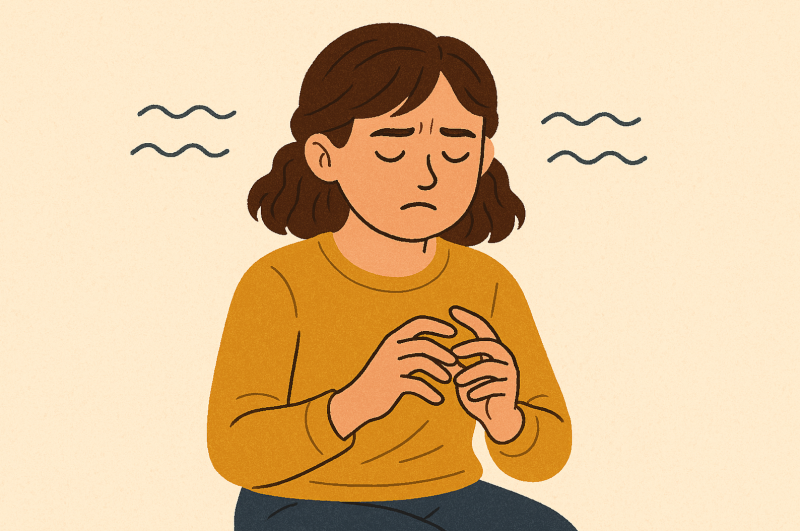
Echolalia and repetitive behaviors are often misunderstood. Here’s what they actually feel like—and why they matter more than most people realize.
By Sergio Toledo
Editor-in-Chief, Heed to Heal
Introduction
There are things we do without always knowing why—repeating the same phrase under our breath, playing a song on loop for days, rewatching a video until it feels like home. These behaviors might seem small, even odd to some. But for many people—especially those who are neurodivergent—they’re deeply personal, comforting, and hard to explain.
Whether it’s called echolalia, stimming, or just “a thing I do,” these repetitive patterns aren’t just quirks. They’re often the body’s way of regulating, processing, or feeling safe in a world that moves too fast.
What Echolalia Really Is
Echolalia is the repetition of words or phrases. It might be something you heard earlier in the day, a line from a TV show, or even something you said to yourself. For some people, it’s immediate. For others, it comes hours—or even days—later.
What’s often misunderstood is that echolalia isn’t meaningless. It can carry emotion, memory, and connection. It’s a way of replaying a moment, testing out how it felt, or holding onto something that made sense. Sometimes it’s a response. Other times, it’s just a way to self-soothe.
It doesn’t mean someone is “broken” or doesn’t understand how to speak. In fact, it’s often quite the opposite—echolalia can be a form of deeper emotional processing that doesn’t always happen in a straight line.
Why Repetition Feels So Safe
Rewatching the same video on your phone over and over. Listening to the same song for days. Saying the same thing quietly under your breath. These are more than habits—they’re rituals. And for many people, they create a sense of predictability in a world that often feels overwhelming.
Repetition gives you control over at least one corner of your environment. You know what’s coming. You know how it ends. You don’t have to brace yourself for anything new. That kind of familiarity can feel like emotional safety.
For some, it’s about emotional regulation. For others, it’s sensory—the rhythm of words, the pattern of movement, or the beat of a song can feel incredibly grounding.
When It’s More than a Quirk
It’s easy to brush these things off as just being “weird” or “stuck in a loop.” But for people on the autism spectrum—or those who are just beginning to recognize their neurodivergent traits—these behaviors are often a core part of how they function.
They’re ways to express joy, manage stress, hold focus, or simply stay emotionally balanced. And while they might look different on the outside, they often serve the same purpose as someone else’s deep breath, fidget, or favorite comfort show.
You’re Not Alone
If you find yourself repeating phrases, fixating on a song, or needing to do something over and over until it “feels right,” you’re not broken. You’re responding to the world in a way your brain understands best. You’re self-regulating, creating comfort, or making meaning—whether or not others see it that way.
It can be hard to explain, especially if no one’s ever talked to you about it before. But there are so many others who feel exactly the same. The words. The rhythms. The small comforts. They’re not wrong. They’re just yours.
References
- Prizant, B. M. (2015). Uniquely Human: A Different Way of Seeing Autism.
- American Speech-Language-Hearing Association. (2023). What Is Echolalia?
- Kapp, S. K. (Ed.). (2020). Autistic Community and the Neurodiversity Movement: Stories from the Frontline.
- Baron-Cohen, S. (2008). The Pattern Seekers: How Autism Drives Human Invention.
Originally published by Heed to Heal, 07.30.2025, under the terms of a Creative Commons Attribution-NonCommercial-NoDerivatives 4.0 International license.